Energy prices remain an important topic for many people. In recent years, energy costs have changed significantly and have often been hard to predict. This raises questions: what will energy prices do in 2026? And what will you notice on your energy bill?
We can't predict the future, but we’ve clearly outlined the key developments and expectations for energy prices in 2026. This will give you more insight into how your energy bill is built up and what you can do yourself to influence your costs.
What influences energy prices?
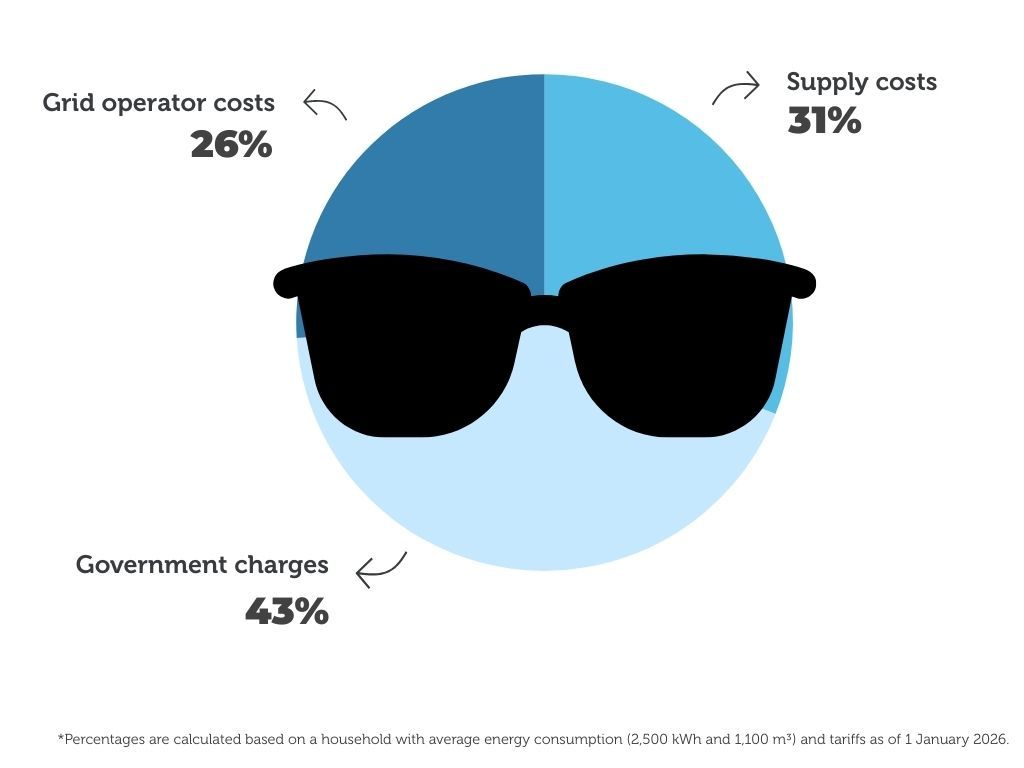
To better understand where your monthly costs come from, it helps to know how your energy bill is structured. The amount you pay depends on how much electricity and, if applicable, gas you use. In addition, the cost of your energy consumption consists of three components:
- Government charges – such as energy tax and the energy tax reduction
- Grid operator costs – for the use of the energy network
- Supply costs (fixed and variable) – per month, depending on your energy supplier and your energy consumption
Together, these components determine what you ultimately pay.
Pie chart illustrating the distribution of energy costs between: grid operator costs (28% of your bill), supply costs (46% of your energy bill) and government charges (26% of your energy bill).
Government charges and grid operator costs
Each year, the government sets the level of energy tax. In 2026, the tax on electricity will decrease, while the tax on gas will increase. Households will also receive slightly less discount through the energy tax reduction.
In addition, grid operator costs will rise. Grid operators are investing in the electricity network to keep it reliable and ready for the future. These costs are reflected on your energy bill.
👉 Want to know exactly what will change? Take a look at our page on government charges and grid operator costs in 2026.
Supply costs: fixed & variable
Every energy supplier charges fixed monthly costs. In the past, these were often referred to as a “connection fee” or compared to subscription costs. These fixed supply costs differ per provider and per type of contract.
In addition, you pay for your actual energy use:
- electricity in kilowatt-hours (kWh)
- gas in cubic metres (m³)
The rates depend on your type of contract (fixed, variable or dynamic) and on developments in the energy market.
What will energy prices do in 2026?
Energy prices have been highly volatile in recent years. Periods of high prices were followed by declines. This mixed picture is expected to continue in 2026.
According to analysts (IEA Electricity Market Report and the ACM), the situation remains uncertain. Energy prices in 2026 depend heavily on global market conditions, the weather and how quickly we transition to sustainable energy.
What we expect in 2026:
- The tax on electricity will decrease
- The tax on gas will increase
- Grid operator costs will rise
- Market prices for energy will continue to fluctuate
What you ultimately pay therefore depends largely on your consumption and the type of contract you have.
Energy price outlook for the coming years
Energy price expectations for the medium term remain uncertain. Prices are influenced by factors such as:
- supply and demand on the international market
- geopolitical developments
- the weather (sun and wind)
- European and Dutch energy policy
The future of gas prices
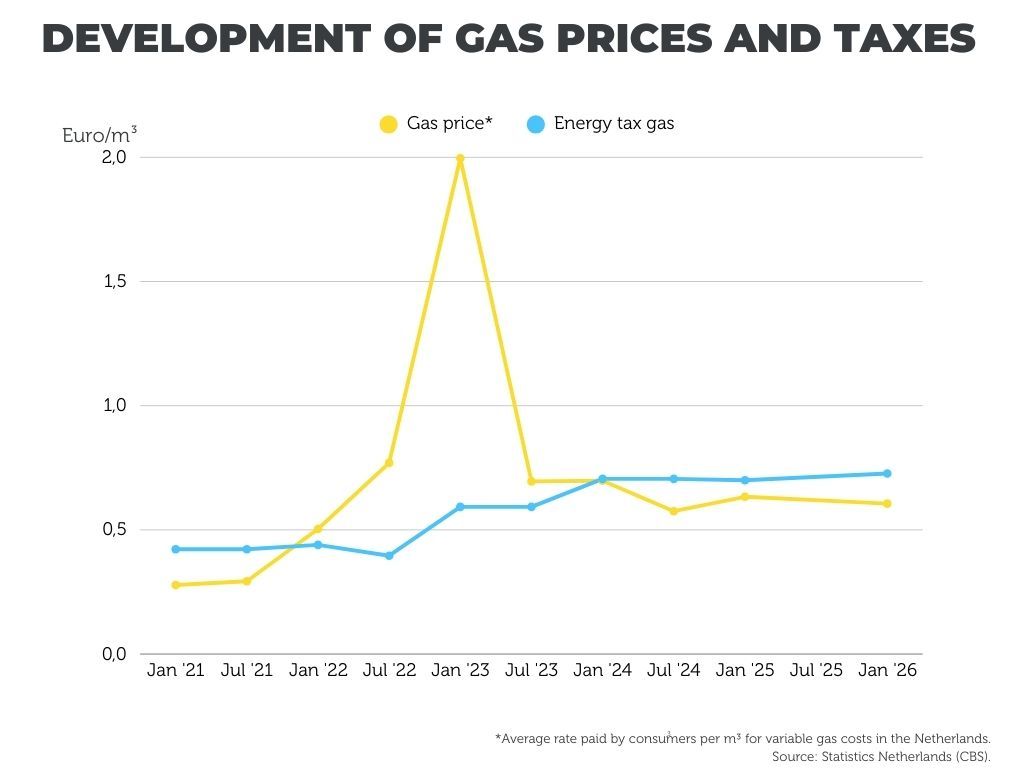
Gas prices rose sharply in 2021 and peaked in 2022. In August 2022, the average gas price, including taxes, was around €2.60 per m³ (consumentenbond.nl).
In 2023, the government introduced a temporary price cap to protect households from these high costs. This price cap has since been abolished. Since then, gas prices have once again followed market movements. Prices are lower than during the 2022–2023 peak, but remain sensitive to fluctuations.
Gas will remain part of the energy supply for the time being. In 2026, the tax on gas will increase, making gas use relatively more expensive.
Electricity prices in the long term
The outlook for electricity prices in 2026 and beyond is generally more favourable than for gas. We are generating more and more sustainable electricity from solar and wind energy. When generation is high and demand is low, electricity can even become very cheap.
With dynamic tariffs, we therefore increasingly see hours with low or even negative electricity prices. By adjusting your consumption to these moments, you can benefit directly.
At the same time, energy storage is becoming increasingly important. Batteries make it possible to use generated electricity later, for example in the evening. This helps the electricity grid and reduces dependence on more expensive peak moments.
The share of renewable energy continues to grow, but fossil sources will still influence electricity prices for the time being. In addition, rules around net metering are changing (ending in 2027), and more suppliers are charging feed-in fees. Using generation, storage and consumption smartly is therefore becoming increasingly important.
What can you do yourself?
Fortunately, you can also influence your energy costs yourself:
⚡️ Use less energy
For example by improving insulation, taking shorter showers, using energy-efficient appliances and being mindful of your electricity and gas use.
⚡️ Generate your own electricity
For example through a Paneelopnaam with Vrijopnaam, without feed-in costs.
⚡️ Use energy smartly
By using electricity at times when prices are low.
The better you align your consumption with the market, the less sensitive you are to price fluctuations. Generating (and storing) your own electricity can be attractive given the expected energy prices in 2026. Your type of contract also plays a role.
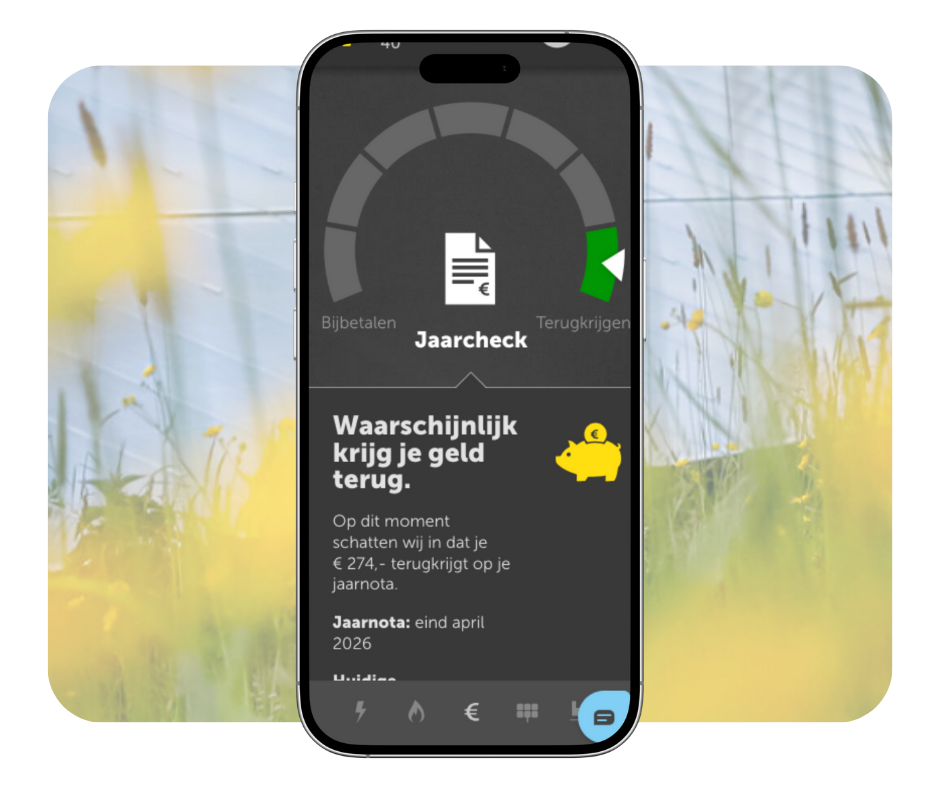
What does this mean for your energy bill in 2026?
Energy prices in 2026 show a mixed picture. Electricity tax will decrease, but gas will become more expensive and grid operator costs will rise. What you ultimately pay depends on your consumption, your contract and the choices you make.
By using energy consciously, consuming smartly and making use of sustainable electricity, you can keep more control over your energy bill.
Vrijopnaam helps you move forward 💡
Would you like more control over your energy costs? With Vrijopnaam, you choose 100% Dutch solar power and carbon compensated natural gas. Choose a solar panel in your name and generate your own electricity: sustainable and cost-effective. You can easily purchase a Paneelopnaam via the Vrijopnaam app. Want to know more about producing your own solar power, or do you have questions after reading this page? Feel free to contact us.
Slimme vragen over energieprijzen
Read all questionsThe Vrijopnaam app is available as a web application. This new technology ensures that you always have insight via the app. On any device.
How does it work?
- Type in vrijopnaam.app in your internet browser.
- Put the url shortcut on your home screen and you're done!
How it's done on iOS devices
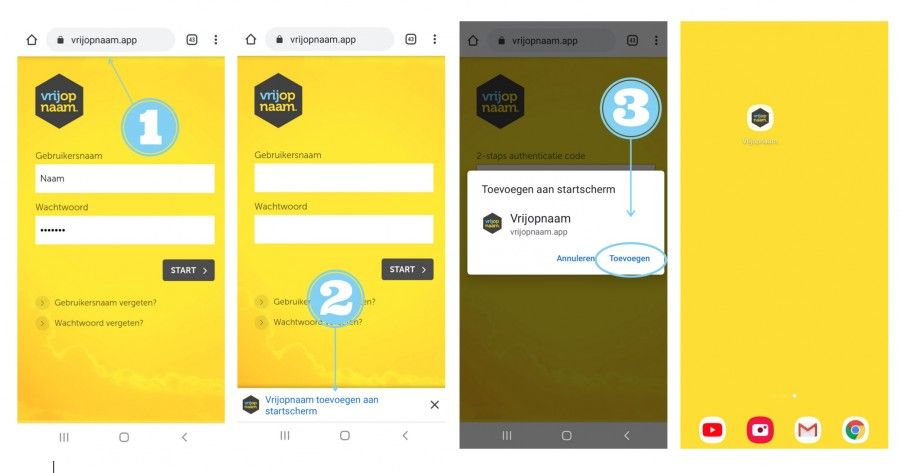
How it's done on Android devices

If you want to buy Panelenopnaam, just select “Paneelopnaam kopen” from the menu in the right upper corner of the Vrijopnaam app. Here you can find more information, for instance about the amount of Panelenopnaam available for you, given your power demand.
Off-peak hours apply from 11pm to 7am, on weekends and public holidays. In the provinces Noord-Brabant and Limburg, off-peak hours apply from 9pm to 7am.
You pay the off-peak commodity rate for the power consumption during these hours. For the other hours (normal hours) you pay the normal commodity rate.
A dynamic rate has its advantages, but sometimes disadvantages as well. This differs per situation.
Advantages: on average you are cheaper (provided you consciously choose to consume at the right times). You benefit from hours with a low electricity rate. You have more control over and influence on your energy bill.
Disadvantages: to gain financial benefits, it is necessary to invest time and attention in your energy consumption and its timing. Consciously running the washing machine at times when the electricity price is low requires more attention than when you have a fixed rate and it doesn't matter when you use energy at home.
Not everyone can manage their consumption well or is flexible about it. So the dynamic tariff should suit your situation.
Vrijopnaam’s mission is to enable everyone to produce their own solar power. That’s why we offer 'Panelenopnaam' to our customers. These are solar panels that are not mounted on domestic rooftops, but placed in collective solar fields operated by Vrijopnaam.
A single Paneelopnaam costs € 99. With this Paneelopnaam, you are entitled to a minimum yield of 250
kWh per panel per year, for a period of 9 years. The yield of your
Paneelopnaam gets settled on your annual statement. The value of this
power equals your own Vrijopnaam power commodity price, with a maximum
of € 0,08 per kWh. The supply rate is the rate of Vrijopnaam excluding VAT and energy tax.
The monthly installment amount is based on your historical annual consumption and the current applicable rates. We receive your historical annual consumption (also called Standard Annual Consumption or SJV) from the grid operator. It is based on the energy usage at your address in previous years. Using this data, we calculate your expected annual energy costs, including energy taxes, grid fees, and fixed supply charges. The monthly amount is then calculated by dividing the expected annual cost by twelve.
Bellen naar 085-30 32 652 kan op werkdagen tussen 9.00 en 17.00 uur. Mailen kan altijd!