
Every year, the Dutch government presents new tax plans on Prinsjesdag. Grid operators also adjust their tariffs. These changes affect your energy bill.
On this page, you can read what will change in 2026 regarding government levies (taxes) and grid costs. We explain it in a clear and simple way and show what this means for your energy costs. At the bottom of the page, you’ll also find answers to frequently asked questions.
What are government levies?
The government charges a levy on the energy you use. This is called energy tax. The purpose of this tax is to encourage more efficient energy use.
We include this tax in your monthly instalment and pay it to the government on your behalf. The amount of energy tax you pay depends on how much electricity and gas you use.
Energy tax in 2026: what will change?
From 1 January 2026, the energy tax will change:
- The energy tax on electricity will decrease from € 0.1228 per kWh to € 0.1108 per kWh (incl. VAT).
- The energy tax on gas will increase from € 0.6996 per m³ to € 0.7267 per m³ (incl. VAT).
For a household with an average energy consumption (2.500 kWh of electricity and 1.100 m³ of gas), this means:
- Around € 30 less energy tax on electricity per year
- About € 29.81 more energy tax on gas per year
Overall, this change has little impact on the total energy bill in this example.
Energy tax reduction in 2026
Energy is a basic necessity. That’s why Dutch households receive a fixed annual discount on the energy tax. This is called the energy tax reduction.
Every home with an electricity connection is entitled to this discount. The amount is automatically deducted from your energy bill.
- From 1 January 2026, the energy tax reduction will decrease from € 635,19 to € 628,96 per year (incl. VAT).
Overview of energy taxes in 2025 and 2026
In the overview below, you can see the most important changes at a glance.
| Energy tax (incl. VAT) |
2025 | 2026 | Difference |
|---|---|---|---|
| Energy tax per kWh per kWh |
€ 0,1228 |
€ 0,1108 | Decrease of € 0,0120 |
| Gas tax per m3 per m3 |
€ 0,6996 | € 0,7267 | Increase of € 0,0271 |
| Energy tax reduction per year |
€ 635,19 |
€ 628,96 | Decrease of € 6,23 |
Government levies on electricity and gas apply to the first usage bracket:
- Electricity: 0–10,000 kWh
- Gas: 0–170,000 m³
Different tax rates apply to consumption above these thresholds.
What are grid costs?
Grid operators ensure that the Dutch electricity and gas networks remain reliable and safe. They maintain the network, install and read meters, and manage connections, for example for solar panels.
In the Netherlands, we have regional grid operators such as Liander, Enexis and Stedin. Together, they work on a stable and sustainable energy grid. The costs for managing and maintaining the network, as well as meter rental, are paid via your energy supplier. These are called grid costs (also known as transport costs).
These grid costs are included in your monthly advance payment. We then pay them to the grid operator.
Grid costs in 2026
According to the Authority for Consumers & Markets (ACM), grid transport costs will increase by approximately 3.38% in 2026.
For a household with average energy consumption, this means:
- An annual increase of about € 25, including VAT
This increase is due to major investments grid operators need to make to keep the increasingly congested electricity grid reliable.
What does this mean for your energy bill?
Due to:
- higher taxes on gas,
- a lower energy tax reduction,
- and increasing grid costs,
energy costs will rise in 2026.
For a household with average consumption (2,500 kWh of electricity and 1,100 m³ of gas), this means about € 30 more per year compared to 2025, assuming the same supply rates.
Finally
At Vrijopnaam, you can choose between fixed, variable and dynamic contracts. The nice thing is that you can easily switch between contract types when your situation changes. No extra costs, and quickly arranged.
Whatever you choose, with Vrijopnaam you always use 100% Dutch solar electricity and CO₂-compensated gas.
Want to know more? Read our article about the advantages and disadvantages of the different contract types at Vrijopnaam.
Saving energy also remains a smart way to keep your costs down. In the Vrijopnaam app, you can track your energy use and easily adjust your monthly instalment via the annual check, based on the 2026 tariffs.
Antwoord op de meest gestelde slimme vragen
Read all questionsYour actual rates for electricity (and natural gas) can be found in the Vrijopnaam app. Log in and choose 'contract en tarieven' (contract data & rates) in the menu in the right upper corner of the page. Here you can find all actual and historical rates at any time.
If you are not (yet) a Vrijopnaam customer, you can find all Vrijopnaam current rates for electricity and natural gas at the bottom of the page.
The Vrijopnaam app is available as a web application. This new technology ensures that you always have insight via the app. On any device.
How does it work?
- Type in vrijopnaam.app in your internet browser.
- Put the url shortcut on your home screen and you're done!
How it's done on iOS devices
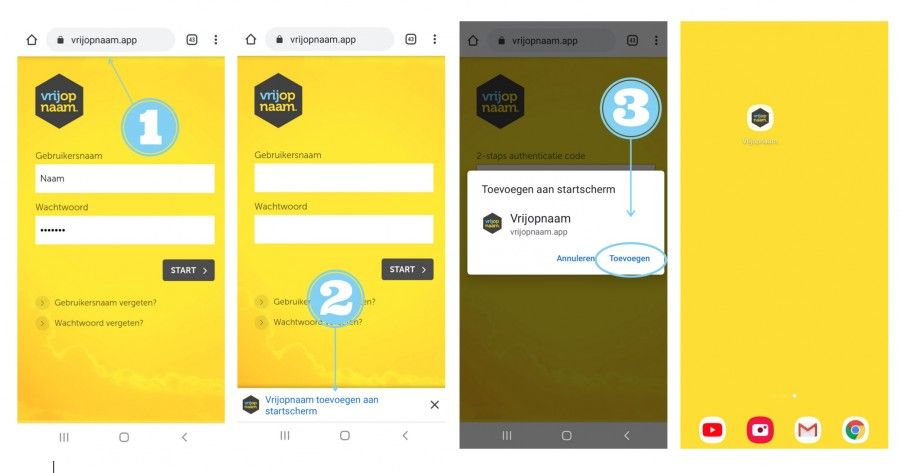
How it's done on Android devices

Bij een vast contract veranderen je tarieven niet tot dit contract afloopt. Daarna ga je automatisch naar een variabel maandtarief. Één maand voor de start van deze maand publiceren we de tarieven in de Vrijopnaam-app. Je vindt de tarieven in het menu (rechtsboven) onder ‘contract en tarieven’.
The Vrijopnaam app provides you with insight into your electricity and natural gas consumption on an hourly, daily, monthly and annual basis. You can easily see your standby consumption and the impact of moments when you have forgotten to turn off the heating. Real insight into your energy consumption makes you aware of your usage patterns and uncovers saving opportunities.
Also check out the "Milieu Centraal” website for useful saving tips or (when you want to practice your Dutch) read our blog with saving tips.
Je betaalt uiteindelijk voor wat je opmaakt. Op de eerste plaats loont het daarom om zo veel mogelijk energie te besparen. Dat zorgt voor een demping van de kosten.
Je kunt in de Vrijopnaam-app volgen wat je verbruikskosten per maand zijn. Heb je afgelopen maand minder opgemaakt? Dan kun je het termijnbedrag verlagen. Houd je verbruik dus goed in de gaten.
Verwacht je een betalingsprobleem? Neem contact met ons op. Daarnaast is het verstandig om contact op te nemen met je gemeente. Zij hebben budgetcoaches die je kunnen helpen met je financiën.
Een aantal andere (aanvullende) mogelijkheden:
- Krijg advies via Geldfit n.a.v. een korte test
- Bel de Nederlandse Schuldhulproute (0800-8115). Ze verwijzen je door naar passende hulp en bieden een luisterend oor
- Misschien kom je in aanmerking voor schuldhulpverlening. Op deze website van het juridisch loket vind je meer informatie.
Bellen naar 085-30 32 652 kan op werkdagen tussen 9.00 en 17.00 uur. Mailen kan altijd!